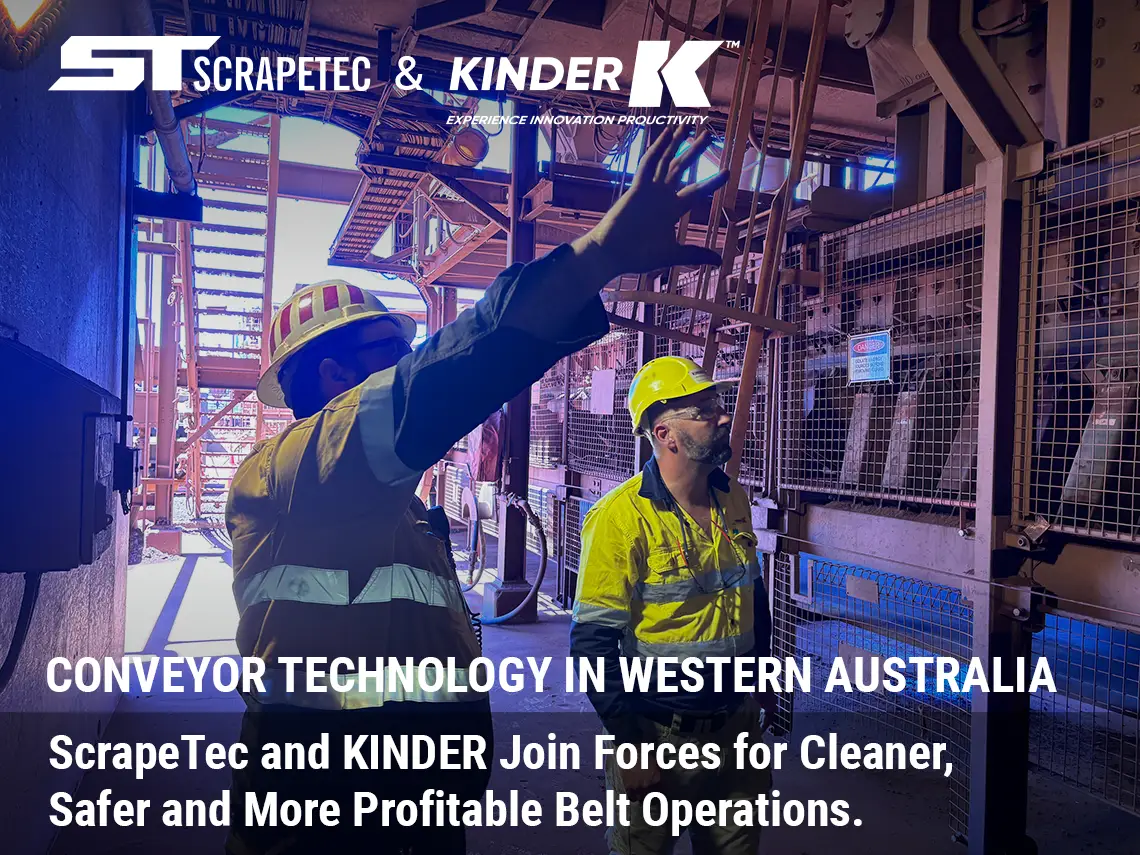
Conveyor Technology in Western Australia: ScrapeTec and KINDER Join Forces for Cleaner, Safer, More Profitable Belt Operations
Western Australia represents industrial scale like few other regions. In the iron ore districts of the Pilbara, as well as in gold and lithium operations and port and handling facilities, conveyor systems run around the clock—across kilometre-long routes, in harsh climatic conditions, and at very high throughputs. At this magnitude, conveyor performance is no longer only about productivity; it is increasingly about compliance, safety, and the industry’s social licence to operate.
Operator requirements have shifted noticeably in recent years. In addition to availability and tonnage, occupational safety, environmental regulations, dust management, emissions reduction, and sustainable plant operation have moved to the centre of attention. This is precisely where a new distribution partnership targets the Australian market for sealing systems and dust control in conveying: ScrapeTec in Germany and the KINDER Group in Australia.
Under the partnership, KINDER assumes distribution of ScrapeTec sealing systems and technologies in the Australian market. In practice, this brings a specialised European portfolio into Western Australia’s major mining and conveying regions through an established local provider—with a clear intent: to help operators measurably improve efficiency, reduce emissions, and minimise maintenance.
A Distribution Partnership with a Clear Value Proposition
The starting point is typical for modern mining ecosystems: operators need solutions that are robust, scalable, and seamlessly integrated into local operations and maintenance processes. ScrapeTec contributes deep technology expertise focused on conveyor sealing and material-flow optimisation. KINDER contributes market knowledge, proximity to sites, service capability, and direct access to operators, EPCs, and maintenance organisations.
This division of roles is more than a sales model—it is an operational enablement approach. ScrapeTec delivers patented core technology; KINDER ensures that design, implementation, spare parts availability, and operational adoption work in an Australian context. For operators, this reduces common risks when introducing new solutions: long supply chains, limited local support, differing standards, and unclear accountability. With KINDER as the distribution partner, ScrapeTec products in Australia are not merely “imported”; they are embedded into the market’s existing value creation.
Why Conveyor Sealing and Dust Control Are Strategic in Western Australia
In Western Australia, conveyors are not just transport equipment; they are critical production arteries. Any uncontrolled material escape along the route—whether via spillage, carryback, or dust emissions—has direct economic and safety consequences:
- Occupational safety: Material build-up creates slip and trip hazards, complicates inspections, increases combustible load, and leads to additional manual cleaning in potentially hazardous areas.
- Environmental and dust compliance: Dust emissions are increasingly monitored. Uncontrolled dust is not only an environmental and community issue; it is also an operational burden, affecting sensors, bearings, drives, and electrical components.
- Asset availability and cost: Spillage and carryback are classic drivers of unplanned downtime, increased wear, additional water/cleaning demand, and material loss.
- Sustainability: Less dust, less cleaning, lower material losses, and optimised energy and maintenance profiles support more sustainable operations—an aspect gaining weight in ESG reporting and permitting frameworks.
Against this background, sealing systems and dust-management solutions are not “peripheral”; they are key levers for performance and compliance.
KINDER Expands Its Portfolio with ScrapeTec—Including Patented AirScrape Technology
A key element of the partnership is the expansion of KINDER’s portfolio with ScrapeTec solutions, including the patented AirScrape technology. AirScrape is designed to minimise material escape and dust generation at critical transfer points—where conveyor systems most often “leak” in practice: chutes, transfer stations, and loading points with turbulent airflow and fine materials.
Technically, transfer points are driven not only by mechanics but also by aerodynamics. With high belt speed and falling bulk material, air turbulence can carry fine dust into the surrounding environment and separate particles from the material stream. Solutions that address these flow and sealing challenges often do more in the field than conventional belt scraping alone—they intervene earlier in the process, at the source of dust generation.
For Western Australia mine operators, this creates a decisive advantage: dust management is treated not as downstream cleanup, but as preventive process stabilisation. The impact is twofold: fewer external emissions and less internal secondary wear.
Deployed in the Largest Mines: Conveyors as High-Performance Infrastructure
The largest mines in Western Australia operate conveyor lines designed for maximum throughput. Belt widths, speeds, and transfer points are optimised for bulk transport—often 24/7, with minimal maintenance windows. In this environment, solutions must combine three properties:
- Robustness against abrasion, varying particle sizes, moisture, and temperature extremes.
- Scalability for large belt widths and diverse transfer scenarios.
- Maintainability: quick access, low adjustment sensitivity, and clear inspection logic.
KINDER’s distribution and service capability is essential here: technology alone is not decisive—implementation into shutdown planning, spares management, and safety procedures is. In Western Australia, where distances are vast and time windows are tight, locally anchored support becomes a genuine operational argument.
Economic Benefits for Large Plants: From Material Loss to OPEX
The business case for sealing systems and dust-control technologies is increasingly data-driven. Operators no longer ask, “Does it work?” but “How fast does it pay back—and how stable is the benefit over time?” Typical value areas include:
1) Efficiency gains and higher availability
Reduced spillage and carryback lower cleaning and repair effort. Less build-up means fewer unplanned stops, less emergency maintenance, and more stable conveying performance. In high-throughput plants, even small availability improvements can be economically significant.
2) Emissions reduction and improved compliance
Less dust at transfer points not only supports environmental and safety goals but also reduces follow-on costs: fewer dust deposits on sensors, less contamination in drive areas, lower load on extraction systems, and fewer cleaning interventions in high-risk zones.
3) Maintenance minimisation and longer component life
Material escape acts as a cost multiplier: it stresses idlers, structures, covers, and electrical infrastructure. Reducing dust and spillage decreases wear across the entire conveyor route—lowering OPEX not just locally, but system-wide.
4) Sustainable operation
Sustainability is tangible here: less material loss, lower water and energy demand for cleaning, fewer spare parts, and fewer site trips and interventions. In remote operations, every avoided additional task supports both efficiency and emissions performance.
Safety: Fewer Manual Interventions, Less Exposure
Safety strategies in conveying consistently aim to reduce manual work around running equipment and minimise exposure in hazardous areas. Dust and spillage issues, however, often force extra walkdowns, cleaning, and inspections—exactly the activities modern safety concepts want to reduce.
Sealing systems and technologies such as AirScrape contribute indirectly but decisively: less escape means less cleaning demand. Less dust means lower exposure in areas otherwise regularly affected by fine particles. A “cleaner” asset condition also improves the visibility of leaks, cracks, and anomalies—supporting inspection and preventive maintenance.
In short: dust and material control is safety engineering.
Digitalisation of Conveyors: From Component to Data Source
Another driver in Western Australia is the rapid digitalisation of conveyor operations. Operators invest in condition monitoring, asset health, predictive maintenance, and central control rooms. In that context, solutions are valued not only for mechanical performance, but also for how they fit into digital operating models:
- Planned maintenance instead of reactive cleanup: stable control of material escape enables standardised, data-based maintenance cycles.
- Better data quality: dust and contamination impair sensors and vision systems; reducing emissions improves the reliability of monitoring and diagnostic data.
- Standardisation across sites: major operators want to scale best-practice solutions across multiple assets. A partnership that combines technology with local execution supports rollouts.
ScrapeTec and KINDER therefore position themselves not only as product suppliers, but as enablers of more modern operating models: fewer disruptions, better predictability, and greater transparency.
Local Strength Meets Patented Technology—For the Next Generation of Conveyor Operations
Mining and materials handling in Western Australia face a dual performance pressure: maximum productivity alongside rising demands for safety, environmental compliance, and sustainability. In this reality, solutions are needed that address root causes—especially at the critical conveyor points where dust and material escape originate.
The distribution partnership between ScrapeTec (Germany) and KINDER (Australia) targets exactly this. KINDER distributes ScrapeTec sealing systems in the Australian market and expands its portfolio with the patented AirScrape technology. Operators benefit from a strong technology offering delivered through a locally established partner—supporting fit-for-market design, implementation, and service.
For large plants, the result is clear: higher efficiency, reduced emissions, minimised maintenance, and conveyor systems that align better with digital and sustainable operating strategies. In a market where “clean operations” have become hard currency, this is not a nice-to-have—it is a decisive competitive factor.
Autor
Thorsten Koth