Optimization of Conveyor Transfers through Contactless Sealing Systems
Conveyor transfer points are among the most technically demanding and critical areas in bulk material handling systems. At these locations, high impact energies, large material volumes, and fine particles converge in confined spaces. The consequences are well known: significant dust emissions, material losses, increased wear on belts and seals, and unplanned downtime that reduces overall system availability. Against this backdrop, innovative contactless sealing systems are increasingly gaining attention as a sustainable solution to these challenges.
Conventional sealing systems are typically based on mechanical contact between the seal and the conveyor belt. While this contact is necessary to limit material escape, it inevitably leads to abrasion. Seals wear out, require frequent readjustment or replacement, and not only generate maintenance costs but also cause damage to the conveyor belt itself. In addition, fine particles escape as dust, negatively affecting occupational safety and the environment while causing valuable material to be lost from the process.
A modern alternative is offered by contactless sealing systems such as AirScrape. This system completely eliminates mechanical contact between the seal and the conveyor belt. Instead, specially arranged hardened blades create a directed airflow using the Venturi effect. This airflow acts as an invisible barrier: fine particles and dust that would otherwise escape at the transfer point are guided back onto the conveyor belt. Sealing is therefore achieved through aerodynamics rather than friction.
The key characteristics of such a system include:
- Contactless operation without mechanical contact with the conveyor belt
- Special blade geometry to generate a directed airflow
- No measurable wear and no need for readjustment
- Maintenance-free operation over several years
Initial Situation: Losses Due to Dust, Wear, and Downtime
In typical conveyor systems with multiple transfer points, conventional sealing solutions frequently cause problems. Continuous abrasion of rubber seals necessitates regular intervention. In practice, this leads to unplanned downtimes occurring at intervals of just a few weeks, each lasting several hours. In addition to direct production losses, further costs arise from labor, spare parts, and maintenance activities.
Particularly critical is the gradual loss of material. Fine particles escaping as dust accumulate to substantial quantities over the course of a year. Even a seemingly minor dust and material loss of around 2% of annual production can have noticeable economic consequences, depending on the value of the material. At the same time, dust emissions degrade working conditions and increase cleaning efforts along the entire conveyor route.
Results After Installation of a Contactless Sealing System
After installing a contactless sealing system, the effects are clearly measurable. Dust emissions are reduced by more than 90%, and seal-related downtime is completely eliminated. Because there is no contact between the seal and the belt, neither seal wear nor belt damage occurs. Production reliability increases significantly, and maintenance work at transfer points is virtually eliminated.
Another decisive advantage lies in the recovery of previously lost material. Fine dust that once left the system now remains in the process and directly contributes to usable production output. This effect has an immediate and positive impact on the overall economic efficiency of the conveyor system.
Economic Example – Efficiency Improvement in Copper Handling
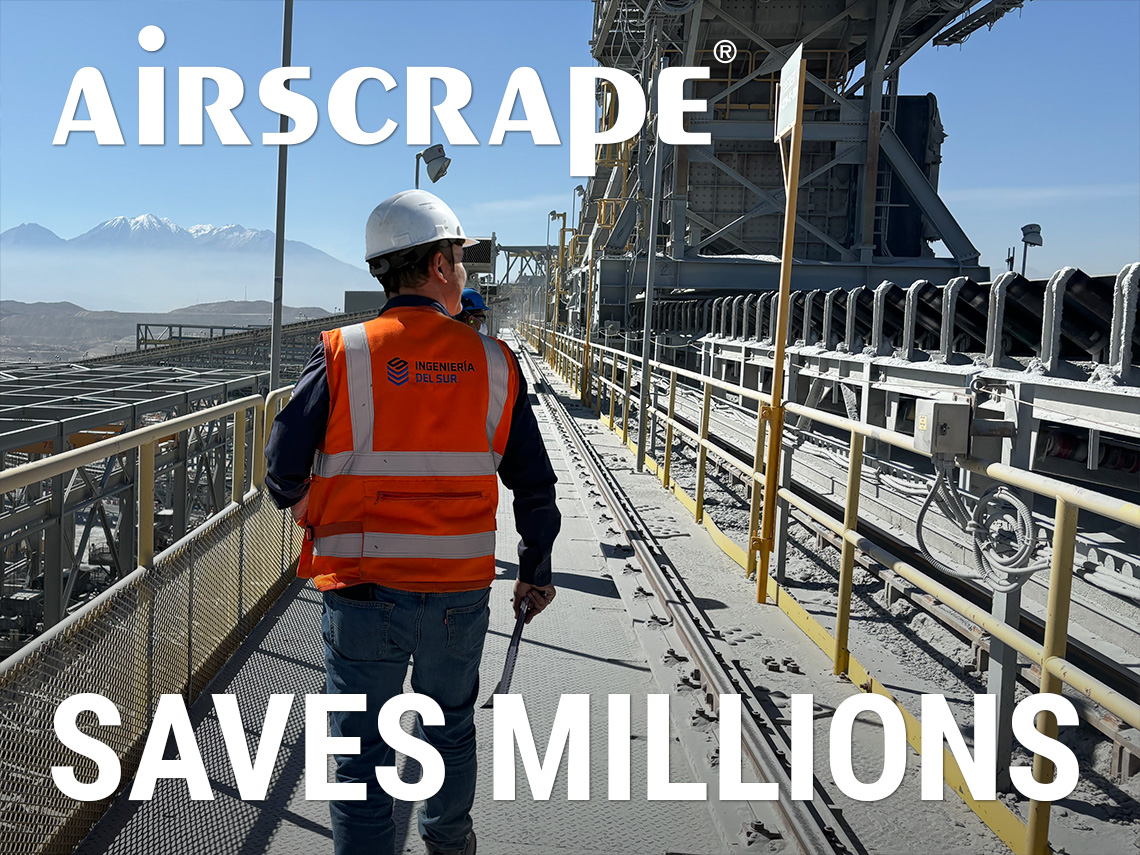
To illustrate the economic impact of contactless sealing systems, the following example considers a copper handling operation. A modern conveyor system with an annual capacity of approximately 300,000 tons of copper loses around 2% of its production due to dust emissions at conveyor transfer points. This corresponds to an annual material loss of roughly 6,000 tons of copper.
Assuming a copper price of approximately USD 10,000 per ton, these losses amount to an economic impact of around USD 60 million per year. In addition to pure material losses, further costs arise from regular cleaning, maintenance, and repair work at transfer points. These activities cause unplanned downtime, resulting in downtime costs of approximately USD 200,000 per month.
By implementing a contactless sealing system such as AirScrape, these losses and associated costs can be almost entirely eliminated. The contactless operating principle drastically reduces dust emissions at transfer points, keeps material within the process, and eliminates seal-related downtime. At the same time, wear on belts and seals – along with the associated maintenance effort – is minimized.
The economic benefit therefore results both from the recovery of previously lost material and from the significant reduction in downtime and maintenance costs. Compared to these savings, the investment costs for purchasing and installing the system are relatively low and, particularly for high-value bulk materials such as copper, are recovered within a very short period.
Environmental and Occupational Safety Aspects
In addition to economic benefits, environmental and occupational safety aspects are becoming increasingly important. The significant reduction in dust emissions improves air quality at workstations, reduces cleaning effort, and minimizes environmental impact. Legal limit values and occupational safety requirements can be reliably met. Since the system operates maintenance-free, accident risks associated with service and adjustment work are also reduced.
Contactless sealing systems such as AirScrape clearly demonstrate the potential of modern technologies in bulk material handling. They simultaneously reduce dust, wear, and downtime while significantly increasing usable system output. Especially in the case of high-value materials, even small percentage losses can result in substantial economic damage. By combining higher availability, lower maintenance costs, and effective material recovery, the investment pays for itself quickly while also contributing to improved safety and sustainability.